English

iiMedia Research released the New Economy Unicorn Series list, with 6 Hubei companies making the list.
Xingqi Technology was established in 2018 in Wuhan Economic and Technological Development Zone. It is currently the only domestic full-stack local chip supplier capable of covering key high-computing-power chips required from smart cockpits to autonomous driving. The company has been awarded the national-level "Little Giant" title for specialized and sophisticated enterprises, included in the Ministry of Industry and Information Technology's recommended catalog of automotive chips, and recognized as a key enterprise in Hubei Province's artificial intelligence industry chain.
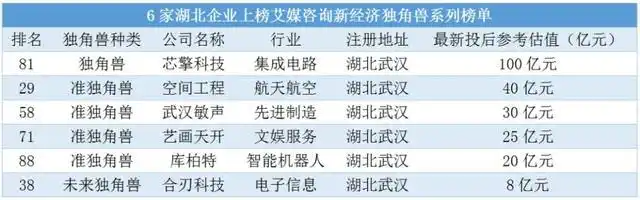
On October 31, iiMedia Research, a global third-party data mining and analysis institution for the new economy industry, released the 2024 China New Economy Unicorn Enterprises Top 100 Series List. Six companies from Hubei made the list, all based in Wuhan.

Xinqing Technology was listed as a new economy unicorn with a valuation of 10 billion yuan. Space Engineering, Wuhan Minsheng, Yihuatiankai, and Cobot were listed as new economy quasi-unicorns with valuations exceeding 2 billion yuan each. HeRen Technology was listed as a new economy future unicorn with a valuation of 800 million yuan.
Founded in 2018 in Wuhan Economic & Technological Development Zone, Xinqing Technology is currently the only domestic full-stack chip supplier capable of covering key high-computing-power chips required from smart cockpits to autonomous driving. It has been recognized as a national-level "Little Giant" specialized and innovative enterprise, included in the Ministry of Industry and Information Technology's automotive chip recommendation catalog, and designated as a key enterprise in Hubei's artificial intelligence industry chain.
In 2021, Xinqing Technology launched China's first 7nm automotive-grade smart cockpit chip, "Longying-1," which has since shipped over 600,000 units, ranking first in domestic cockpit chip sales. Recently, in the field of autonomous driving, the company successfully powered up its full-scenario high-end autonomous driving chip, "Xingchen-1." This chip is expected to achieve mass production in 2025 and large-scale vehicle applications in 2026. With multi-chip collaboration, it can deliver up to 2048 TOPS (trillions of operations per second) of computing power, meeting L2 to L4 autonomous driving requirements.
Wuhan Minsheng was established in 2019 in Optics Valley. After years of R&D, the company has achieved domestic substitution and independent mass production of RF filters, currently producing 24,000 wafers and over 1 billion RF filters annually, serving several well-known smartphone manufacturers.
In January this year, Wuhan Minsheng signed an agreement with Donghu High-Tech Zone, announcing a total investment of 3 billion yuan to establish its headquarters and build a high-end RF filter R&D and production base in Optics Valley. The base is currently under construction, with the first phase expected to be completed by mid-next year. Upon full operation, the base will produce approximately 120,000 wafers and 10 billion RF filters annually.
HeRen Technology, also located in Optics Valley, was founded in 2017. By integrating optoelectronic technology with artificial intelligence, the company has invented over 100 patents, focusing on solving practical problems in computer vision. Its technologies can be applied to autonomous and assisted driving, as well as portable spectrometers.
Notably, in terms of the number of listed companies by region, Hubei does not rank particularly high: it ranks 11th nationally with one new economy unicorn, 6th with four new economy quasi-unicorns, and 9th with one new economy future unicorn.
In recent years, Hubei has been actively cultivating unicorn enterprises to accelerate the formation of new productive forces and enhance new development momentum.
In January this year, the Hubei Provincial Government Office issued the "Several Measures to Support the Cultivation and Development of Unicorn Enterprises," proposing to focus on selecting enterprises with key core technologies in industrial chains or disruptive industry innovations, strong innovation capabilities, new development models, rapid growth, and promising market prospects for cultivation, based on the province's "51020" modern industrial clusters and "5+9" key industrial layout. A gradient cultivation mechanism of "seed unicorn – potential unicorn – unicorn" will be established.

The measures aim to support "Optics Valley" and "Auto Valley" in creating ecological agglomerations for unicorn enterprises. By supporting corporate R&D innovation, guiding various capital investments, and assisting market expansion, the goal is to have over 240 enterprises in the provincial unicorn cultivation and development database by 2025, including at least 55 unicorn and potential unicorn enterprises.